Types of Home Water Filtration Systems and What They Target
Home water filtration systems target different problems, such as sediment, chlorine, dissolved minerals, microbes, or specific contaminants. At PlumbingAuburnwa.info, we use the water source, test results, flow needs, and point of use to guide system selection.
Request an Estimate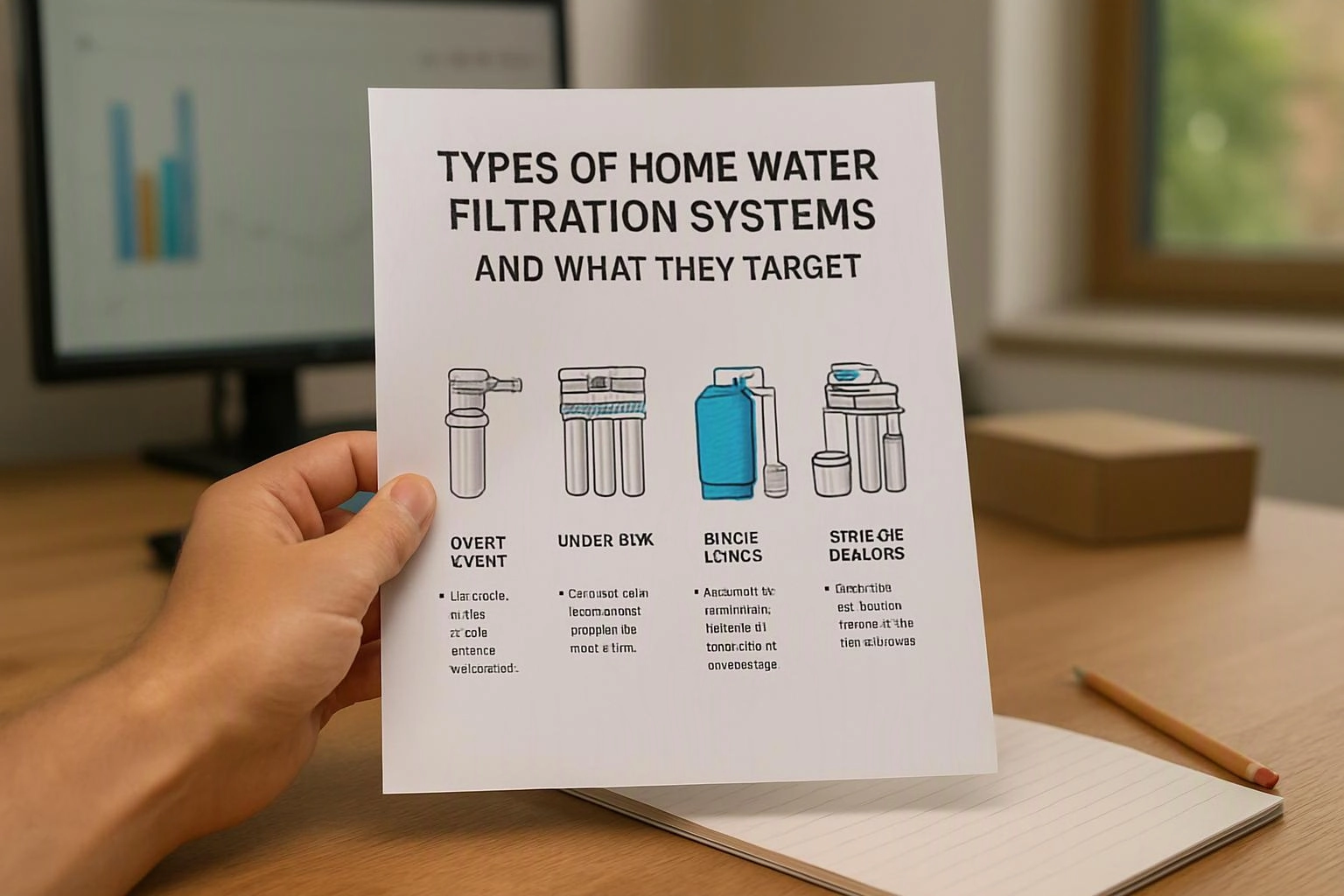
How Water Filtration Systems Target Different Problems
Water filtration systems target specific contaminants, so the right choice depends on what the water contains and where treatment is needed.
Water quality testing helps identify sediment, chlorine, dissolved minerals, microorganisms, and other water contaminants. We also consider taste, odor, water pressure, and the flow rate needed at each fixture.
Some systems filter drinking water at one faucet. Other systems treat water as it enters the home. The best match depends on the water source and the treatment goal.
The Main Types of Home Water Filtration Systems
The main system types include sediment filters, carbon filters, reverse osmosis, ultraviolet treatment, water softeners, and specialty filters.
Each system uses different filter media or treatment methods. The table shows the main target for each option.
| System type | Main target | Common placement |
|---|---|---|
| Sediment filter | Sand, silt, and rust particles | Whole-house prefilter or point of use |
| Activated carbon filter | Chlorine, taste, odor, and some organic compounds | Whole-house or under-sink system |
| Reverse osmosis system | Dissolved solids, salts, and selected dissolved contaminants | Under-sink drinking water system |
| Ultraviolet water purifier | Bacteria, viruses, and other microorganisms | Whole-house treatment train |
| Water softener | Hardness minerals such as calcium and magnesium | Whole-house plumbing system |
| Iron filter | Iron-related staining, taste, and odor | Whole-house treatment |
| Whole-house water filter | A selected group of contaminants throughout the home | Point of entry |
| Point-of-use filter | Drinking water at a specific faucet | Kitchen faucet or under-sink cabinet |
Sediment Filters for Sand, Silt, and Rust
A sediment filter is a physical barrier that catches sand, silt, and rust particles. A prefilter can protect later treatment stages and reduce debris reaching faucets and appliances.
We select the filter housing and media for the water source and expected flow rate. Sediment control may be needed before carbon, ultraviolet, or reverse osmosis treatment.
Activated Carbon Filters for Taste, Odor, and Chlorine
An activated carbon filter reduces chlorine, taste, odor, and some organic compounds. Granular activated carbon and carbon block filters use different forms of carbon media.
Carbon filtration and UV treatment serve different purposes. Carbon targets selected chemicals and taste concerns, while UV uses light for disinfection and does not remove dissolved chemicals.
Reverse Osmosis for Dissolved Contaminants
A reverse osmosis system pushes water through a semipermeable membrane to reduce dissolved solids, salts, and selected heavy metals. The system commonly uses an under-sink layout with a storage tank.
Reverse osmosis can include prefilters and post-filters. We check the drain line, faucet, shutoff valve, water pressure, and available cabinet space during installation planning.
Ultraviolet Treatment for Microorganisms
Ultraviolet water treatment uses ultraviolet light to inactivate bacteria, viruses, and other microorganisms. The process provides disinfection but does not remove sediment, chlorine, or dissolved minerals.
Sediment prefiltration helps keep the water clear enough for the light to work properly. We place the UV unit within a treatment setup that matches the water source and flow needs.
Water Softeners and Specialty Filters
A water softener treats hard water by reducing calcium and magnesium that can cause scale. An iron filter targets iron-related staining, taste, or odor when testing shows iron is the concern.
Whole-house treatment can combine a softener with sediment, carbon, iron, or other specialty filtration. The right combination depends on the test results and the needs of the plumbing system.
What Does Each Water Filter Remove or Reduce?
Each filter targets a different group of contaminants, and no single system removes every water quality problem.
Filter media, contact time, system design, and maintenance all affect contaminant removal. Use test results and the product’s certified claims when comparing systems.
| Water concern | System that may target it | Important point |
|---|---|---|
| Sediment | Sediment filter | The filter captures physical particles. |
| Chlorine and taste and odor | Activated carbon filter | The result depends on carbon type and contact time. |
| Volatile organic compounds | Selected carbon systems | Check the system’s certified contaminant claims. |
| Dissolved solids and salts | Reverse osmosis system | The membrane produces a treated water stream and a drain stream. |
| Microorganisms | Ultraviolet water treatment | UV treatment disinfects water but does not remove particles or chemicals. |
| Iron | Iron filter | Treatment depends on the form and level of iron. |
| Hardness minerals | Water softener | Softening addresses hardness, not every contaminant. |
Whole-House and Under-Sink Filters Serve Different Needs
Whole-house filters treat water as it enters the home, while under-sink filters treat water at one faucet.
A whole-house water filter uses point-of-entry treatment for drinking water, shower water, laundry, and other fixtures. An under-sink water filter uses point-of-use treatment for a focused drinking water need.
We compare the required water flow, installation location, plumbing connections, and maintenance access. A whole-house system may need greater capacity, while an under-sink system may focus on one faucet and a storage tank.
When Do Water Filter Supply and Installation Work Together?
Water filter supply and water filtration system installation work together when the treatment equipment must match the home’s water quality and plumbing.
Our team reviews the water quality assessment, filter sizing, and plumbing connections before recommending equipment. These scenarios often require both services:
We coordinate equipment selection with the installation plan. That approach helps prevent a filter from being placed where it cannot receive the needed flow or service access.
How Water Filter Selection and Installation Fit Together
Water filter selection and installation fit together through testing, planning, connection checks, and maintenance access.
Our water filter supplier service supports the equipment side, while our installation work confirms that the system fits the home.
Our quote scope explains the selected equipment, connection work, installation location, and expected maintenance needs. We review code and inspection requirements that apply to the plumbing and electrical connections.
How We Choose a Water Filtration System for a Home
PlumbingAuburnwa.info chooses a water filtration system by matching the water source and test results to household demand and plumbing conditions.
This process keeps the system focused on the actual water problem. It also helps our team plan a clean connection that can be maintained later.
What Changes the Cost of a Home Filtration Project?
The cost depends on the treatment method, system capacity, installation location, plumbing changes, and ongoing filter needs; we provide an exact quote after reviewing those factors.
System type and treatment capacity affect equipment requirements. The number of treatment stages, installation location, plumbing modifications, and electrical requirements also affect the project.
Replacement filters and maintenance needs shape the long-term cost. We explain what the quote includes and how to request an exact quote through our contact page.
What to Check Before Choosing a Water Filter
A water filter should match the water quality report, test results, contaminant claims, capacity, and maintenance needs.
Check whether the system targets the specific contaminant found in the water. Also review the flow rate, maintenance schedule, replacement cartridge, and available drain connection.
Ask whether the filter has suitable certification for its stated contaminant reduction. Our team also checks water pressure, plumbing compatibility, installation access, and the space needed for service.
Choose the Right Water Filtration System for Your Goal
The right home water filtration system depends on whether the goal is drinking water treatment, whole-home treatment, hard water control, microbial treatment, or sediment control.
Carbon filtration can address chlorine, taste, odor, and selected organic compounds. Reverse osmosis can reduce selected dissolved contaminants, while UV treatment focuses on microorganisms.
Water softeners target hard water, and sediment filters target physical particles. We match the water filter supplier selection with water filtration system installation so the equipment fits the water source, flow needs, and plumbing layout.
Questions About Home Water Filtration Systems
Can one water filtration system remove every type of contaminant?
No, one water filtration system doesn't remove every type of contaminant. Each system targets certain problems, so testing helps determine whether combined treatment is needed.
Do I need a whole-house filter or an under-sink filter?
A whole-house filter suits water treatment at the point of entry, while an under-sink filter suits drinking water treatment at one point of use. The choice depends on the contaminants, water flow, and fixtures that need treated water.
Can reverse osmosis and carbon filtration be used together?
Yes, reverse osmosis and carbon filtration can be used together when the treatment goals and system design support both stages. Carbon often serves as a prefilter or post-filter, while the membrane targets selected dissolved contaminants.
Does ultraviolet water treatment remove sediment or chemicals?
No, ultraviolet water treatment doesn't remove sediment or chemicals. UV treatment uses light for disinfection, so sediment prefiltration may be needed before the UV chamber.
How often do home water filters need replacement?
Home water filters need replacement according to the filter type, water quality, system capacity, and manufacturer maintenance schedule. We review access to the cartridge or housing so replacement can be handled safely and properly.